NEWS
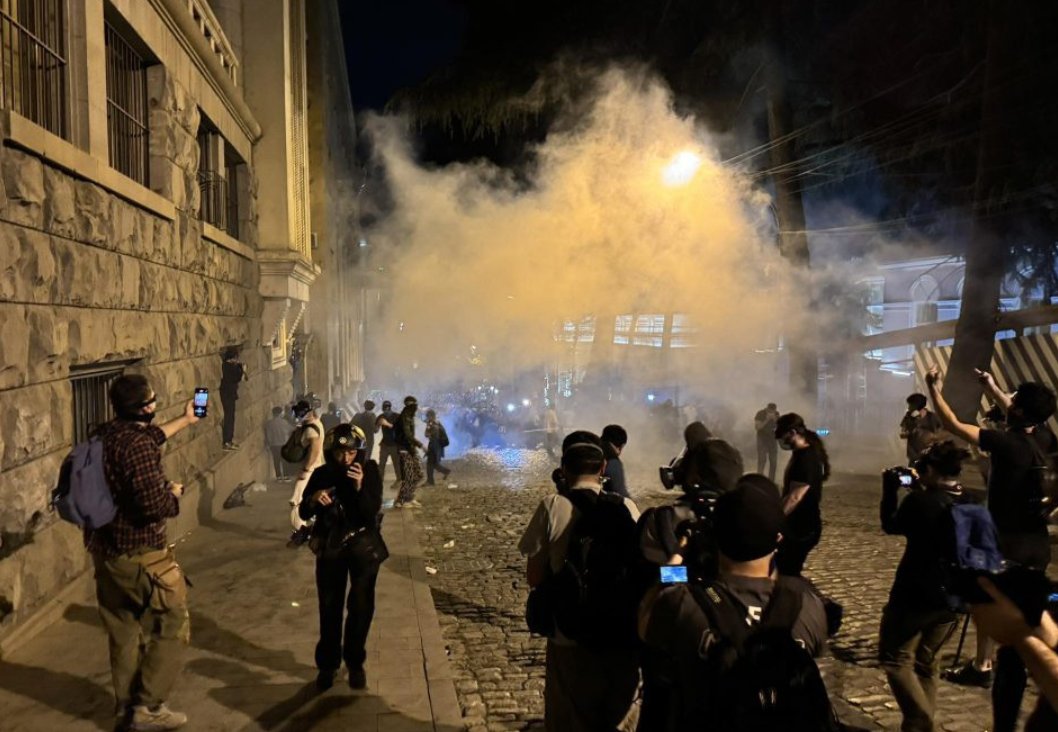
On October 21, 2024, the Georgian Ministry of Internal Affairs issued a statement in which it effectively confirmed the parallel use of tear gas and water cannon against participants in anti-Russian law protests (April-May 2024), claiming that this does not violate international standards and domestic law, and that the ministry's actions against the demonstrators were legal and proportionate, which, according to GYLA, is false.
First of all, we would like to remind the Ministry of Internal Affairs that such a prohibition also exists in the Order of the Minister of Internal Affairs No. 1002 (Article 9.1.p), which defines the guidelines for the conduct of internal affairs officers during assemblies and demonstrations, and according to which the simultaneous or parallel use of water cannon and tear gas against protest participants is prohibited. This finding is also cited by the European Court of Human Rights in its judgment about events of June 20, 2019 in the case of Tsaava and Others v. Georgia (para. 147) and confirms that the parallel and simultaneous use of these means is prohibited under Georgian legislation. It should be emphasized that this order is not publicly available in the official gazette, and GYLA requested it from the Ministry during the monitoring of various protests. It is unknown on what basis the Ministry of Internal Affairs claims that there is no norm prohibiting the simultaneous use of active special means, and if so, this means that the Ministry of Internal Affairs has worsened the instructions for dispersal operations and changed the said norm.
The MIA statement, misleadingly, quotes the text of the Amnesty International guidance document in the wrong context. According to the document, The water cannon can deliver a mixture of water with marker dye and/or chemical irritants, although the document draws attention to the negative consequences of this practice, stating that “The use of a mixture of water and chemicals makes it impossible to control the precise doses of the irritant, which – in addition – may have a longer term impact on the individual person.” 1 Moreover, the Amnesty International guidelines explicitly call for the use of water canons with chemicals or paint to be prohibited. 2
According to both national legislation and international standards— including the guidelines referenced in the Ministry’s own statement—special means should be used only in a lawful,proportionate manner and with minimal intensity. 3 Water cannons and tear gas should be employed strictly as a last resort to control a group participating in an assembly, only when violence has escalated to a point where targeted measures against violent individuals are no longer sufficient to contain the threat. 4 However, during the protests against the 'Russian law,' the law enforcement officers used special means against peaceful demonstrators without appropriate grounds or necessity, resulting in serious violations of human rights standards including instances of possible torture and inhuman treatment. 5
We call on the Ministry of Internal Affairs:
Publicize Order No. 1002 of the Minister of Internal Affairs and provide information on whether the norm prohibiting law enforcement from using active special means, including water cannon and tear gas, simultaneously or in parallel, has been changed.
1 Amnesty International, USE OF FORCE GUIDELINES FOR IMPLEMENTATION OF THE UN BASIC PRINCIPLES ON THE USE OF FORCE AND FIREARMS BY LAW ENFORCEMENT OFFICIALS, 2015, 159, https://policehumanrightsresources.org/content/uploads/2015/01/ainl_guidelines_use_of_force_0.pdf?x86271
2 Amnesty International, LESS LETHAL WEAPONS: Water Cannons, https://www.amnesty.nl/content/uploads/2024/03/Water-cannon-1.pdf?x82004
3 Amnesty International, USE OF FORCE GUIDELINES FOR IMPLEMENTATION OF THE UN BASIC PRINCIPLES ON THE USE OF FORCE AND FIREARMS BY LAW ENFORCEMENT OFFICIALS, 2015, 159, https://policehumanrightsresources.org/content/uploads/2015/01/ainl_guidelines_use_of_force_0.pdf?x86271
4 Ibid
5 For more details on these and other violations, see GYLA's report "Georgia: Human Rights amidst Russian Law", 2024. https://gyla.ge/files/Human%20rights%20Amidst%20the%20russian%20law.pdf
SHARE: