NEWS
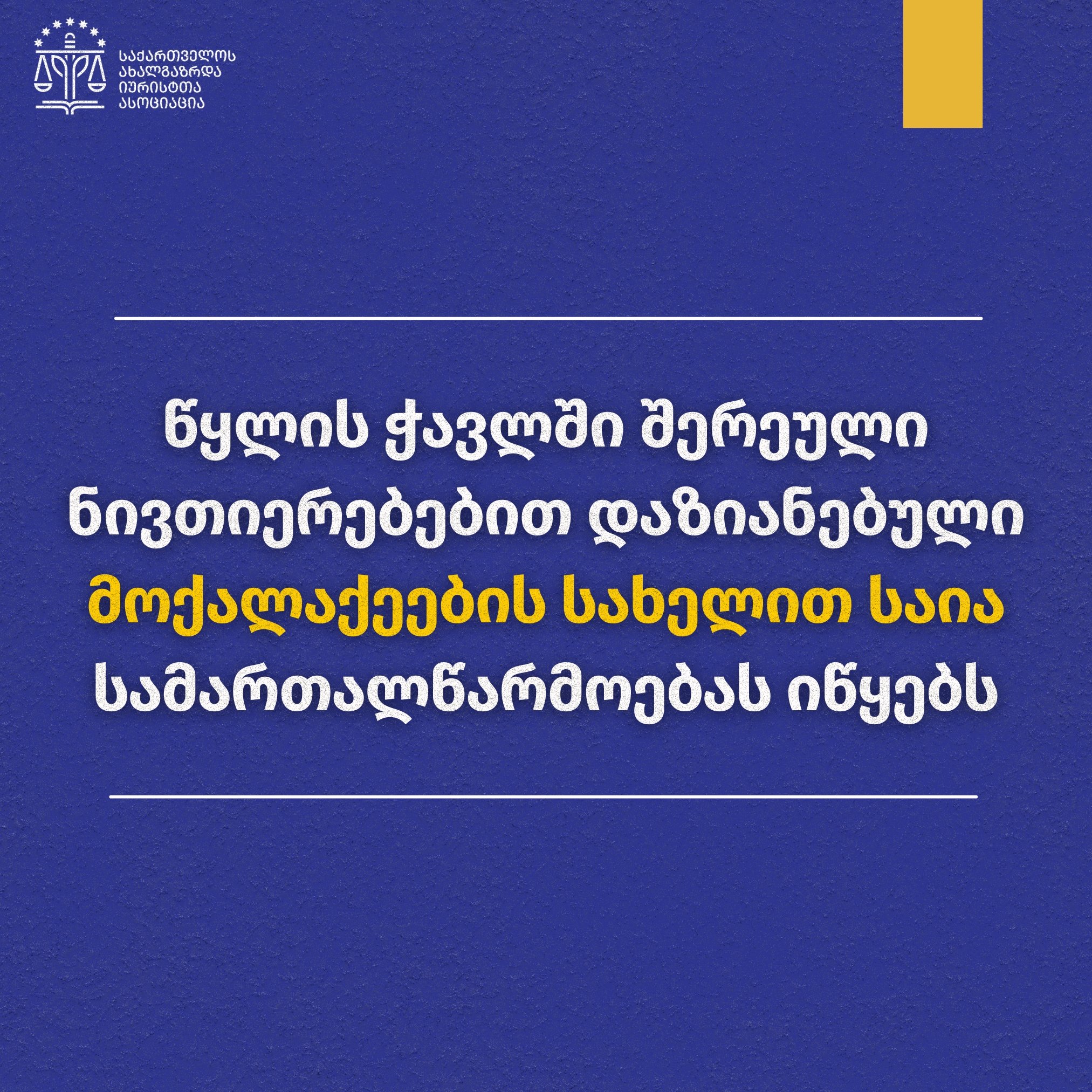
GYLA initiates legal proceedings on behalf of citizens who were harmed by substances mixed into water cannons and is addresses the Prosecutor’s Office of Georgia through appropriate communication.
Specifically, as is known to the public, in November-December 2024 the Ministry of Internal Affairs of Georgia used various types of special means to disperse demonstrations.1 On 1 December 2025, the BBC published a documentary film and an article suggesting that, during the dispersal of the November-December 2024 demonstrations, the authorities allegedly used the chemical compound bromobenzyl cyanide (“camite”), which was mixed into water cannons. On 1 December 2025, the State Security Service launched an investigation under Article 333 of the Criminal Code (exceeding official powers), as well as Article 319 (assistance to a foreign organisation in hostile activities). On 6 December 2025, the State Security Service released a statement confirming the fact that a chemical substance had been mixed into water cannons, however, according to the Service, this chemical substance was not camite, but “chlorobenzylidene malononitrile.” According to the information disseminated by the Service, “bromobenzyl cyanide,” i.e. “camite,” has never been procured by the Ministry of Internal Affairs of Georgia.
We highlight that the issue of mixing chemical irritants into water cannons in Georgia is not clearly regulated: neither the Law of Georgia “On Police” nor the Ministry of Internal Affairs’ instructions contain norms that would establish such a practice, while the old version of Order No. 1002 of 2015 directly prohibited the simultaneous use of water cannons, rubber bullets, and tear gas, has been removed from the current text without the introduction of additional legality standards. As a result, water cannons saturated with chemical irritants cannot be considered a “legally prescribed” means of managing assemblies and contradict both national and Convention requirements that the use of force be lawful, necessary, and proportionate.
Until December 2025, based on publicly available information about the mixing of chemical substances into water cannons and the threats associated with it, as well as interviews with protest participants, GYLA repeatedly addressed this issue.2 Some demonstrators who were exposed to water cannons reported health problems, in particular skin burns, deterioration of vision, respiratory insufficiency, neurological problems, allergic reactions, hearing impairment, joint pain, thyroid-related problems, and others.3
Until December 2025, despite calls, the State did not disclose information regarding which chemical means it had used in November-December 2024.4 In January 2025, GYLA submitted a request for public information to the Ministry of Internal Affairs, asking which chemical substances were used during the police operations carried out in November-December 2024, which chemical substances were mixed into the water cannons, and in what concentration.5 GYLA did not receive a response from the Ministry of Internal Affairs. In January 2025, according to information requested by GYLA from the Ministry of Health, the Ministry also did not possess information about the composition of the chemical substances used, and such information had not been requested from the Ministry of Internal Affairs due to the “absence of necessity.”6
It should be noted that on 10 December 2025, the Commissioner for Human Rights of the Council of Europe addressed the Prosecutor General of Georgia by letter, stating that the mixing of chemical irritants into water cannons raises significant questions regarding legality, necessity, and proportionality, and that this issue should be part of the investigation into the use of police force in November-December 2024.7 The Commissioner also notes that in January 2025 the Minister of Internal Affairs had assured him that chemical substances mixed into water cannons had not been used against protest participants.
The investigation conducted by the State Security Service regarding the use of water cannons and chemical substances during the November-December 2024 protests fails to meet the Conventionional standard of an effective and independent investigation, as the same body is simultaneously investigating both the alleged violation (the use of special means) and itself casts doubt on the existence of that violation. In such a configuration, the investigation undermines both institutional/hierarchical and practical independence and aims to create a “chilling effect” on all those who speak out about, or otherwise advocate regarding, socially significant human rights violations.
At this stage, the Georgian Young Lawyers’ Association is providing legal representation to 7 individuals who have informed the organization of various health problems, each of whom continues to suffer from these problems to this day. They link these issues to the special means used against them by the Ministry of Internal Affairs during protest actions in November-December 2024.
By the statement sent to the Prosecutor General’s Office on their behalf, the Georgian Young Lawyers’ Association, taking into account Georgian legislation and international standards, has requested: information on the progress of the investigation; the questioning of the injured individuals; an assessment of the practice of mixing substances into water cannons and its compatibility with crimes defined by the Criminal Code; the conduct of all investigative actions necessary to identify responsible persons; and the recognition as victims of the 7 individuals who sustained various types of health damage as a result of the use of special means by the Ministry of Internal Affairs in November-December 2024.
The Georgian Young Lawyers’ Association continues legal advocacy on this issue at both the domestic and international levels.
1 GYLA et al., Human Rights Crisis in Georgia Following the 2024 Parliamentary Elections, November 28, 2024-February 28, 2025, 2025, https://admin.gyla.ge/uploads_script/publications/pdf/HUMAN%20RIGHTS%20CRISIS%20IN%20GEORGIA%20-%20final.pdf [10.02.2026].
2 GYLA, the use of chemical weapons by the Georgian Dream against peaceful demonstrators in November-December 2024 was illegal and dangerous to health, 02.04.2025,https://www.gyla.ge/post/demosntaciebis-dashla-ucnobi-qimiurishenaerti, [10.02.2026]; GYLA et al., Human Rights Crisis in Georgia Following the 2024 Parliamentary Elections, November 28, 2024-February 28, 2025, 2025, pages 37, 58-59 https://admin.gyla.ge/uploads_script/publications/pdf/HUMAN%20RIGHTS%20CRISIS%20IN%20GEORGIA%20-%20final.pdf [10.02.2026].
3 Ibid.
4 GYLA, The ongoing protest on Rustaveli Avenue is being dispersed with unlawful and disproportionate use of force, 29.11.2024, https://www.gyla.ge/post/%20Darebva-kvlav-araprprciuli-zaliat-da-ukanonod-mimdinareobs, [10.02.2026].
5 GYLA's January 28, 2025 statement No. G-04/21-25 regarding the request for public information from the Ministry of Internal Affairs of Georgia. See: GYLA et al., Human Rights Crisis in Georgia Following the 2024 Parliamentary Elections, November 28, 2024-February 28, 2025, 2025, Annex, https://admin.gyla.ge/uploads_script/publications/pdf/HUMAN%20RIGHTS%20CRISIS%20IN%20GEORGIA%20-%20final.pdf [10.02.2026].
6 Letter from the Ministry of Internally Displaced Persons from the Occupied Territories, Labor, Health and Social Protection, MOH 7 25 00192431, dated February 19, 2025. GYLA's January 28, 2025 statement No. G-04/21-25 regarding the request for public information from the Ministry of Internal Affairs of Georgia. See: GYLA et al., Human Rights Crisis in Georgia Following the 2024 Parliamentary Elections, November 28, 2024-February 28, 2025, 2025, Annex, https://admin.gyla.ge/uploads_script/publications/pdf/HUMAN%20RIGHTS%20CRISIS%20IN%20GEORGIA%20-%20final.pdf [10.02.2026].
7 CommHR/MOF/sf 163-2025, https://rm.coe.int/letter-to-the-prosecutor-general-of-georgia-by-michael-o-flaherty-coun/488029c11a?utm, [10.02.2026].
SHARE: