NEWS
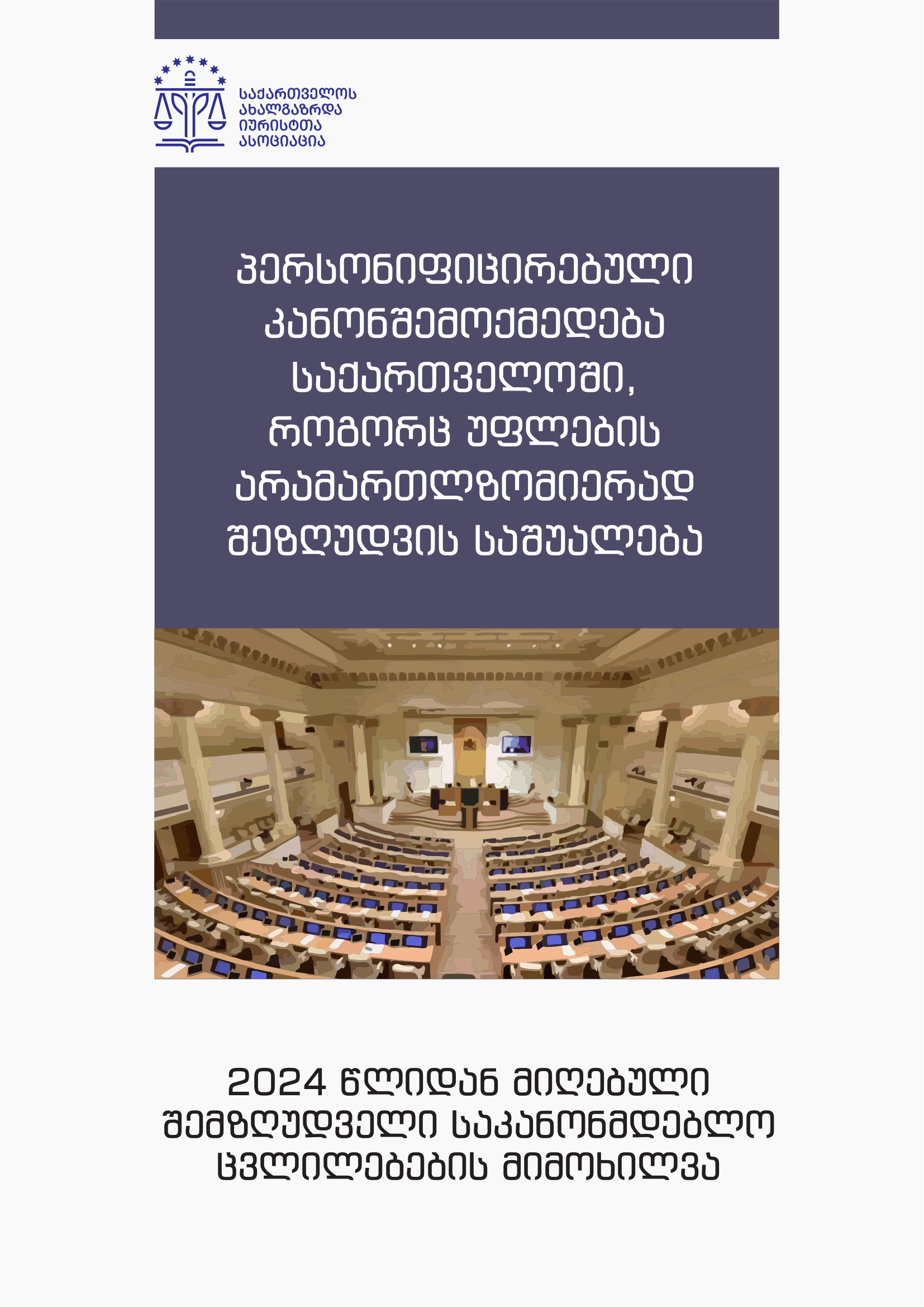
The Georgian Young Lawyers Association has published a publication entitled “Personalized Lawmaking in Georgia as a Means of Unlawful Restriction of Rights”. The document reviews the repressive legislative amendments adopted in Georgia since 2024 and related trends.
Personalized legislation refers to laws that the ruling elites, through the legislature, adopt to consolidate their power or persecute political opponents. In order to suppress protests and worsen the rights of political opponents, the parliament has adopted a number of amendments since 2024, many of them in an expedited manner. From April 3, 2024 to February 20, 2026, 304 laws were initiated and adopted in an expedited manner in the legislature. Some of them were presented in the form of a package, and some - in the form of separate amendments. Changes were made without sufficient discussion and debate.
Some of the acts adopted in this form restrict various fundamental rights. The changes concerned such important issues as, among others, freedom of assembly, freedom of expression, freedom of association, freedom of the media, and the rights of public servants.
In May 2024, the so-called Russian law, which aimed to stigmatize civil society organizations, was adopted by the Georgian Dream against the backdrop of violent suppression of peaceful protests. In 2025, the so-called FARA and the amendments to the Law on Grants in 2025-2026 significantly limited the scope of civil society activities and created legislative mechanisms for the de facto criminalization of civil activism.
Following the October 2024 parliamentary elections and the use of systematic torture against participants in the November-December peaceful protests, repressive lawmaking became even more intense. As a result of several waves of amendments to the Code of Administrative Offenses, the Criminal Code, and the Law on Assemblies and Manifestations, sanctions related to protest activities have significantly increased, and new violations related to protest expression have emerged. The created legislative regulation leads to the actual criminalization of assemblies: the legislative framework, as of today, provides for the obligation to notify the Ministry of Internal Affairs of the assembly, which in content is equivalent to the obligation to obtain a permit, taking into account that it allows the Ministry of Internal Affairs to change the time, place, and route of the assembly, as well as, in the event of partial or complete blockage of the public thoroughfare, the Ministry of Internal Affairs is authorized to make a decision on opening and/or restoring the movement of people. Violation of the warning rule or failure to comply with a mandatory instruction is punishable by administrative imprisonment. The commission of the same act by a person convicted of this act will result in criminal liability (deprivation of liberty for a term of up to one year).
The legislation regulating freedom of expression has significantly deteriorated: the ability of broadcasters to receive foreign funding has been restricted, vague obligations have emerged regarding the impartiality of broadcasters, and photo-video and audio recording in court have been effectively banned. A provision prohibiting insults to officials and public servants has been introduced, which allows for arbitrary use and a punitive effect.
The trend of personalized lawmaking continues actively in 2026. The comprehensive amendments adopted in March 2026 have further tightened restrictions on civil and political activity, including by further tightening the legislation related to grants, introducing new, vague criminal norms, and effectively banning civil society representatives from political party membership.
In addition to the freedoms of assembly, expression and association, repressive, personalized lawmaking has affected many areas of public life, including political pluralism, academic independence, the right to privacy, guarantees of independence for public servants, the rights of LGBTQ people, and the rights of foreigners and stateless persons.
To illustrate the trends in personalized legislation, the document analyzes 27 legislative acts/packages:
1. Russian Law (Georgian Law “On Transparency of Foreign Influence”) - Date of adoption: May 28, 2024;
2. Homophobic/Transphobic Legislative Package - Date of adoption: September 17, 2024;
3. Amendments to the Code of Administrative Offenses and the Law of Georgia “On Assemblies and Manifestations” - Date of adoption: December 13, 2024;
4. Amendments to the Law on Civil Service - Date of adoption: December 13, 2024;
5. Amendments to the Law on the Special State Protection Service - Date of adoption: December 13, 2024;
6. Amendments to the Code of Administrative Offenses and the Law of Georgia “On Assemblies and Manifestations” - Adoption date: February 6, 2025;
7. Amendments to the Criminal Code - Adoption date: February 6, 2025;
8. Amendments to the Law “On Public Service” and consequential amendments - Adoption date: February 20, 2025;
9. The so-called FARA and consequential amendments - Adoption date: April 1, 2025;
10. Amendments regarding the abolition of the mandatory participation of civil society in the decision-making process - Adoption date: April 2, 2025;
11. Amendments related to the removal of the term “gender” from the legislation - Adoption date: April 2, 2025;
12. Amendments to the Law on Broadcasting - Adoption Date: April 1, 2025;
13. Amendments to the Law on Grants - Adoption Date: April 16, 2025;
14. Amendments to the Code of Administrative Offenses, the Criminal Code and other acts (regarding the tightening of drug policy) - Adoption Date: April 16, 2025, July 2, 2025;
15. Amendments to the Law on Political Unions of Citizens - Adoption Date: May 13, 2025;
16. Amendments to the New Rules of Procedure of the Parliament of Georgia - Adoption Date: May 13, 2025;
17. Amendments to the Law on Speech and Expression - Adoption Date: June 26, 2025;
18. Amendments to the Organic Law “On Common Courts” (Restriction on Video/Photography and Audio Recording in Court) - Date of Adoption: June 26, 2025;
19. Amendments to the Law “On the Legal Status of Foreigners and Stateless Persons”, the Criminal Code and other laws - Date of Adoption: June 26, 2025;
20. Amendments to the Law of Georgia “On Operational-Investigative Activities” and the Criminal Procedure Code - Date of Adoption: July 2, 2025;
21. Amendments to the Law “On Political Unions of Citizens” and consequent amendments to other legislative acts - Date of Adoption: October 16, 2025;
22. Amendments to the Codes of Administrative Offenses and Criminal Law - Date of adoption: October 16, 2025;
23. Amendments to the Law on “Mental Health” and consequential amendments - Date of adoption: December 9, 2025;
24. Amendments to the Code of Administrative Offenses and the Law on “Assemblies and Manifestations” - Date of adoption: December 10, 2025;
25. Revised Election Code - Date of adoption: December 17, 2026;
26. Amendments to the Law on “Higher Education” - Date of adoption: February 4, 2026;
27. Amendments to the Laws "On Grants" and "On Political Unions of Citizens", the Code of Administrative Offenses and the Criminal Code - Date of adoption: March 4, 2026;
The lawmaking process should be conducted in a context of deliberation, openness, and the involvement of all important actors and their expression of opinion. Sufficient time should be allocated to it so that the addressees of the norm have the opportunity to express their motivated position on it. The more interference with a fundamental right increases, the more deliberative the legislative process should be. The legislative amendments and lawmaking trends analyzed in the document demonstrate that lawmaking in Georgia is conducted with disregard for democratic principles. Repressive, personalized lawmaking is used as a political tool to persecute dissent and strengthen power, thus blatantly violating the constitutional principles of a legal and democratic state and fundamental human rights.
SHARE: