NEWS
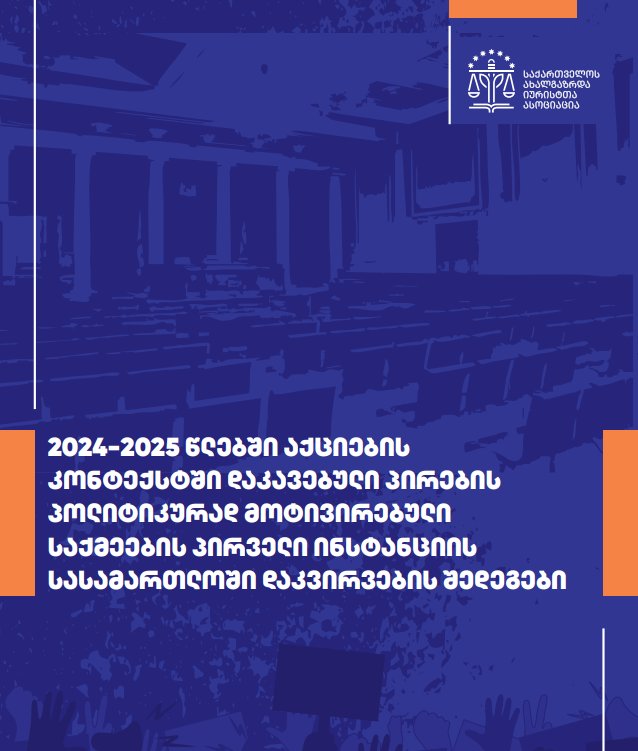
GYLA, based on court monitoring, has prepared a report: Results of Observing Politically Motivated Cases at First Instance Courts Involving Persons Detained in the Context of Protests in 2024-2025. GYLA monitored almost 300 criminal court hearings involving 69 individuals. For monitoring purposes, cases were selected based on the following criteria:
· Criminal cases related to the alleged persecution of individuals for political or civic activism;
· Cases of persons detained under criminal law as a result of protests against the “Russian law” (spring 2024);
· Criminal cases of persons detained in the context of protests following November 28, 2024.
GYLA considers these cases to be politically motivated and believes the predominant purpose of the proceedings is retaliation against dissent.
The report is available at the following link.
KEY FINDINGS
Observation of criminal cases before the first instance courts reveals that the use of criminal prosecution mechanisms against activists is not directed solely at identifying and preventing specific alleged criminal acts, but also serves as a means of exerting pressure on the rights to freedom of assembly and expression. This practice does not represent an isolated violation of rights but contains elements of political motive / hidden intent.
Charges Brought
Activists are mostly charged with crimes such as: organizing or participating in group violence; preparation of an explosion; assaulting a police officer; damaging or destroying property by arson, explosion, or other dangerous means; unlawful production, manufacture, acquisition, storage, transportation, or transfer of narcotic substances, their analogues, or precursors in particularly large quantities; attempting to block a strategic facility and other.
Use of Detention as a Measure of Restraint
At the first stage, courts almost invariably imposed, and subsequently in most cases left without changes, the strictest form of measure of restraint - detention. Courts granted the motions of prosecution for usage of detention without taking into account circumstances relating to the accused, such as their individual characteristics, personality, occupation, age, health, family and financial situation, and other relevant factors.
According to GYLA’s assessment, the imposition of unsubstantiated and prolonged detention on activists did not serve the legitimate purposes of measure of restraint. The requests for, and imposition of, detention functioned instead as a means of punishing activists and/or exerting pressure upon them.
GYLA’s court monitoring findings over the years demonstrate that detention as a measure of restraint is not always applied strictly as a measure of last resort. In practice, two problematic issues arise: the high rate of detention and instances of unsubstantiated detention.
Cases of Ill-treatment
19% (13 individuals) of detained demonstrators reported instances of ill-treatment during proceedings, which in essence amount to acts prohibited under the Constitution of Georgia and international human rights treaties and are criminally punishable (depending on the circumstances, each may amount to crimes defined in Articles 144¹, 144², 144³ of the Criminal Code – torture, threat of torture, inhuman or degrading treatment).
Allegations of ill-treatment were made by: Saba Skhvitaridze, Revaz Kiknadze, Nikoloz Katsia, Anatoly Gigauri, Davit Khomeriki, Davit Lomidze, Temur Zasokhashvili, Archil Museliants, Anastasia Zinovkina, Artem Gribul, Tevdore Abramov, Aleksandre Elisashvili, and Mzia Amaghlobeli.
In addition, several defendants pointed to problems within penitentiary establishments, in particular: heat and lack of ventilation; the presence of cockroaches in cells; water and canalization problems; and insufficient medical care.
Investigations about cases of ill-treatment are characterized as ineffective. Neither the Special Investigation Service (prior to its abolition on 1 July 2025) nor the Prosecutor’s Office identified responsible individuals. Out of the 13 individuals, only one (Saba Skhvitaridze) was granted victim status, while 12 others were not recognized as victims by the Prosecutor’s Office.
The Principle of Publicity
At the initial stage, publicity was restricted by the arbitrariness of individual judges and/or through the use of small courtrooms, which limited the ability of interested individuals to attend hearings. Subsequently, restrictions were imposed on media coverage of proceedings, and legislative amendments further worsened transparency of the judiciary.
Amendments to the “Organic Law on General Courts” prohibited photo, film, video recording and broadcasting within the court (in the courthouse, courtroom, or court yard), except when this is carried out by the court itself or by a person authorized by the court. Dissemination of recorded materials was left to the discretion of the court, which could decide whether or not to release photos, films, or video recordings of hearings. These amendments practically eliminated the possibility for media to cover court hearings. The provision allowing video and audio recording or broadcasting of a particular hearing upon a specific decision of the High Council of Justice has not functioned in practice. Despite numerous requests by media outlets to get permission to cover criminal proceedings against activists, the High Council of Justice did not even provide responses.
Problems were also noted regarding the publishing information about hearings. Information about criminal cases against demonstrators was not always published on the official website of the court or displayed on monitors specifically designated for this purpose inside the court.
Delays of Cases
The criminal cases of individuals detained in the context of the 2024 spring protests were subject to artificial delays. This was tendentious in cases that had already reached the final stage. The hearings were scheduled with long intervals, mostly once every 2 months, only because of the mandatory requirement to review detention. Representatives of the defence consistently raised objections regarding this practice. The proceedings were not completed in a timely manner on the grounds that President Salome Zurabishvili would not have been able to pardon the activists within the framework of her presidential powers.
Restrictions on the Right to Defence
Another challenge identified in the criminal cases against activists was, in certain instances, restrictions imposed on the right to defence.
In a criminal case involving eleven defendants, the judge unjustifiably appointed public defence lawyers to all of the defendants, except for one defendant, despite the fact that all others were represented by their own lawyers at the hearing. The defendants stated that they did not want involvement of new lawyers. In this situation, there were no legal grounds for the appointment of public defence lawyers. Preventive appointment of a public lawyer is not prescribed by the criminal procedure legislation. Moreover, the factor of trust between a defendant and a lawyer must be taken into account, as the lawyer-client relationship is primarily based on trust. According to the defendants’ position stated during the hearing, they had retained private lawyers precisely for this reason. The court’s actions constituted a serious interference with the defendants’ right to defence.
This raised suspicions that the judge tried to conclude the proceedings within the 9-month detention period in order to avoid change of detention as a measure of restraint due to the expiry of that period.
Issues relating to interpreters were also revealed in the ongoing cases. Lack of interpreter qualifications or significant deficiencies in translation directly restricted the defendants’ rights, particularly in terms of effective defence and the protection of the principle of a fair trial. When defendants are unable to understand the substance of the proceedings against them, including the formulation of the charges, the assessment of evidence, and witness testimonies, they cannot state their position or adequately exercise defence mechanisms. There were identified incidents, where defence lawyers explained that the translation provided by interpreters did not serve the defendant’s interests and was at times significantly insufficient or inappropriate. Challenges concerned both the quality of translation and breaches of neutrality and ethical standards, which constituted a significant barrier to the defendants’ full participation in the proceedings and the effective exercise of their right to defence.
Judgements and Sentences
The approach of prosecuting and judicial authorities in the criminal cases against activists is mostly strict. which was reflected in the predominance of convictions and the imposition of custodial sentences.
All criminal proceedings against activists have been completed (as of September 2025, only the cases of Nino Datashvili and the 2 February events remain under consideration in the court of first instance).
It should be underlined that, except for Giorgi Akhobadze, Tevdore Abramov, and Nikoloz Katsia, all defendants were found guilty by the court.
In several cases, the courts reclassified the charges: for example, in the cases of Anatoli Gigauri, and the so-called “eight” and “eleven” defendants, the charges were reclassified to lighter articles. In case of Saba Skhvitartidze the prosecution itself changed the charges: instead of Article 353¹. 2 of the Criminal Code (assault on a police officer), the case was requalified under Article 120 - Intentional infliction of minor harm to health.
Charges were also reclassified in the case of Mzia Amaghlobeli, founder of “Batumelebi” and “Netgazeti”. Instead of Article 353¹ of the Criminal Code (assault on a police officer, other public official, or public institution), the court convicted her under Article 353 (resistance, threats, or violence against a public order officer or other public official).
8 individuals out of 10 detained during the protests against the “Russian law,” received custodial sentences. As for those detained in the context of the November-December protests, without exception, all convicted individuals were sentenced to custodial penalties in the form of imprisonment.
The criminal proceedings against activists in the Tbilisi City Court, particularly those relating to drug-related crimes, revealed that, in most cases, neutral evidence was lacking. In some cases, the neutrality of witnesses presented by the prosecution as independent raised doubts. Video evidence was often absent, even in situations where it would have been possible to obtain recordings from external cameras likely to capture the search and seizure process. Moreover, in certain cases, the video evidence that was presented raised questions as to its reliability.
Instrumentalisation of the Criminal Law
In response to the planned demonstration of 2 February 2025, the Government of Georgia amended Ordinance of the Government No. 361 of 23 October 2024 on 31 January 2025. The amendment added a single point to the list of “strategic and/or specially designated facilities,” namely, the international highways as defined by Government Ordinance of the Government No. 407 of 18 June 2014 on the approval of the list of international and domestic highways. As a result of this amendment, criminal liability was imposed for blocking Aghmashenebeli Avenue near Tbilisi Mall, which later formed the basis for the prosecution of 8 individuals.
The amendment to the Decree of the Government was introduced within a single day. Consequently, an act that would not have entailed criminal liability the day before became punishable under criminal law. Since the demonstration had been announced prior to the amendment, and the amendment was adopted just one day before the event, the public had no reasonable time to be informed.
The fact that a single provision was added to the Ordinance of the Government one day before the planned demonstration, covering the exact location of the announced protest, raises suspicions that the “Georgian Dream” abuses its powers in an attempt to deliberately hinder the exercise of the fundamental rights to freedom of assembly and expression.
The Impunity of Special Force Officers and Their Commanders
It is alarming that no criminal prosecution has initiated against any individual responsible for violence committed against activists and journalists during the protests.
Furthermore, by abolishing the Special Investigation Service, Georgian Dream once again demonstrated that it does not intend to conduct effective investigations into police violence and ill-treatment, to fulfil obligations undertaken within the EU Association process, to execute the judgments of the European Court of Human Rights, or to take into consideration the recommendations of the Venice Commission.
SHARE: