NEWS
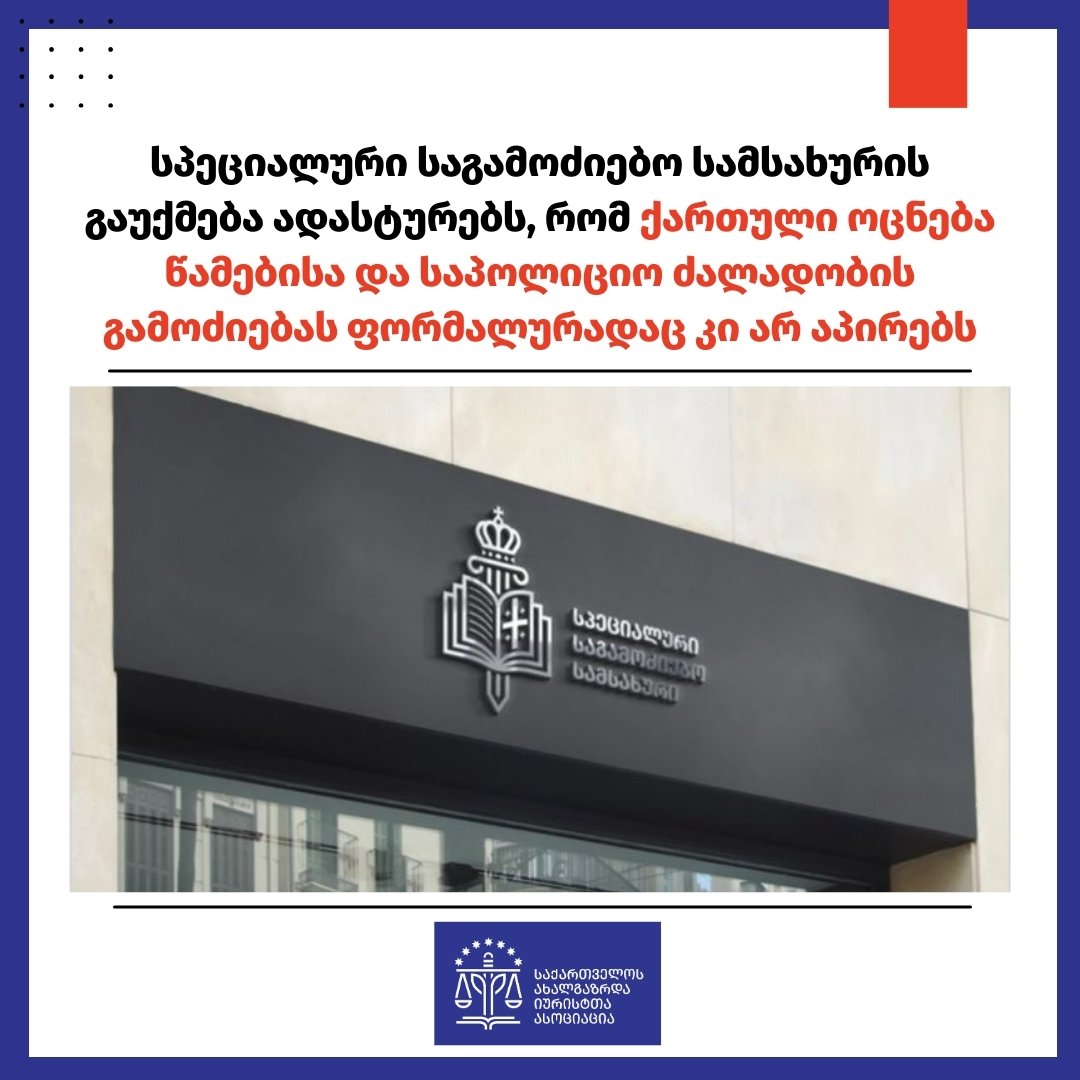
On 19 May, Georgian Dream initiated a bill proposing the abolition of the Special Investigation Service and the transfer of its investigative powers to the Prosecutor’s Office.
It is worth noting that, under the conditions of Georgian Dream’s capture of state institutions, the Special Investigation Service has been ineffective in fulfilling its obligations, effectively contributing to police violence, the torture of peaceful demonstrators, and impunity for perpetrators of inhumane treatment. However, the abolition of this agency further confirms that Georgian Dream is demonstratively refusing to investigate police violence, implement the decisions of the European Court of Human Rights, and fulfill its obligations under the EU Association process.
The creation of an independent agency to investigate crimes and ill-treatment committed by law enforcement officials was prompted by both Georgia’s obligations under the Association Agenda between Georgia and the European Union for 2017–2020 and the need to implement the judgments of the European Court of Human Rights in the Tsintsabadze Group of cases.1
To respond to crimes committed by law enforcement officers, the State Inspectorate was established in 2019, followed by the Special Investigation Service in 2022. It is noteworthy that in 2021, without any prior public consultation, the State Inspectorate was abolished and replaced with two separate bodies—the Special Investigation Service and the Personal Data Protection Service. This decision was widely viewed as a politically motivated attack on an independent institution and drew strong criticism both domestically and internationally.
A significant concern has been the lack of independence of the Special Investigation Service from the Prosecutor’s Office. In 2024, the Committee of Ministers of the Council of Europe, in the context of monitoring the implementation of the Tsintsabadze judgments, called on Georgia to enhance the independence of the Special Investigation Service from the prosecution. Moreover, strengthening the effectiveness, institutional independence, and impartiality of the Service was among the nine key recommendations issued by the European Commission in 2023 as conditions for granting Georgia candidate status. The Venice Commission also recommended that the Georgian state increase the Service’s independence from the prosecution.
It is important to note that the Special Investigation Service, in its current form, was one of the institutions hijacked by Georgian Dream and has failed to fulfill its mandate. Documentation prepared by 11 civil society organizations, as well as the Public Defender’s Parliamentary Report, highlight the Service’s ineffectiveness in investigating police violence, systematic torture, and ill-treatment committed during April–May 2024 and since November 2024—thus contributing to impunity at both the institutional and individual levels.
Beyond the significant human rights concerns and the clear case of dismantling an independent institution, Georgian Dream has manipulatively attempted to justify the Service’s abolition in the explanatory note to the draft law. Specifically, party representatives claim that “based on the principles of constitutional law, the model of state governance should be exclusively regulated by the Constitution. The legal status of an independent state body should be provided for in the supreme law of the country. It is also worth noting that the Constitution of Georgia establishes the competencies assigned to the special administration of the highest state bodies of Georgia, which can only be implemented by the central government of Georgia.” Article 7 of the Constitution of Georgia enshrines the foundations of the country’s territorial organization and delineates the powers of central and local governance. Investigative authority clearly falls within the competence of the central government. The Special Investigation Service, like the Prosecutor’s Office, was established as a central government agency. The fact that it is not explicitly mentioned in the Constitution cannot serve as a legitimate basis for its abolition. Accordingly, the party’s legal justification is unfounded.
Through the abolition of the Service, Georgian Dream once again demonstrates its unwillingness to effectively investigate police violence and ill-treatment, to fulfill its obligations under the EU Association process, to implement the judgments of the European Court of Human Rights, and to heed the recommendations of the Venice Commission.
1 Tsintsabadze's group brings together 18 decisions of the European Court of Human Rights concerning violations of the right to life and the prohibition of torture, which were caused by the actions of police and prison officials and their ineffective investigations.
SHARE: